

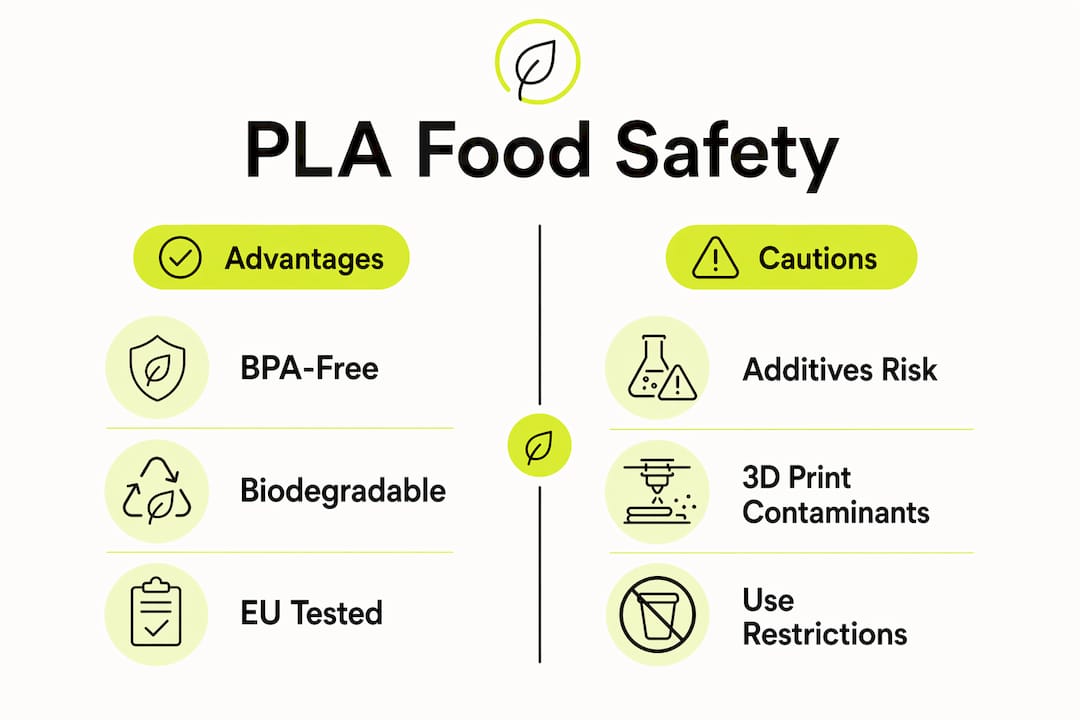
Pure PLA (polylactic acid) does not contain BPA. It is a bioplastic derived from plant sugars, not from bisphenol chemistry, so bisphenol A is simply not part of its molecular structure. That is the short answer. The longer answer matters more: being free of BPA does not automatically make a finished PLA product safe for food contact. Additives, colourants, manufacturing contamination, and physical hygiene limits can all introduce risks that the base polymer never would. Before you use any PLA item with food, check for migration testing and a manufacturer’s certificate that covers the finished product, not just the raw resin.
Table of Contents
- What is PLA and why does it differ from conventional plastics?
- Does PLA contain BPA or phthalates?
- Food-contact rules and what “food-safe” means in the UK
- Why a finished PLA item might still be unsafe for food
- Practical guidance: where PLA is safe to use and what to avoid
- How to confirm a PLA product is food-safe
- PLA, biodegradability, and microplastics
- Which lab tests actually prove a PLA item is safe?
- Key takeaways
- Why the “BPA-free” label is only half the story
- Ready-made PLA alternatives with documented credentials
- Useful sources and further reading
What is PLA and why does it differ from conventional plastics?
PLA stands for polylactic acid, a polyester made by polymerising lactic acid derived from fermented plant sugars, typically corn starch or sugar cane. That feedstock origin is what sets it apart from petroleum-based plastics and, crucially, from bisphenol-containing polymers such as polycarbonate.
Key facts about PLA’s chemistry and physical properties:
- Not a bisphenol polymer. PLA is built from lactic acid monomers, not from bisphenol A or any bisphenol precursor. BPA cannot appear in the base resin by chemistry alone.
- Renewable feedstock. Because it comes from plant sugars rather than crude oil, PLA has a lower carbon footprint at the production stage than most conventional plastics.
- Glass transition temperature of about 60 degrees Celsius. PLA softens at temperatures most households reach easily, which limits its use with hot food and in dishwashers.
- Industrially compostable under the right conditions. PLA breaks down in certified industrial composting facilities; home composting is slower and less reliable.
- Typical migrants are lactic acid and lactide. Migration studies show that what leaches from PLA is primarily lactic acid, a substance already present in food, not BPA or phthalates.
Understanding these properties explains both why PLA is a genuinely different material from BPA-containing plastics and why it still requires careful handling for food applications.
Does PLA contain BPA or phthalates?
No. Pure PLA resin contains neither BPA nor phthalates because it is not synthesised from bisphenol compounds or plasticiser chemistry. This is a structural fact, not a marketing claim.
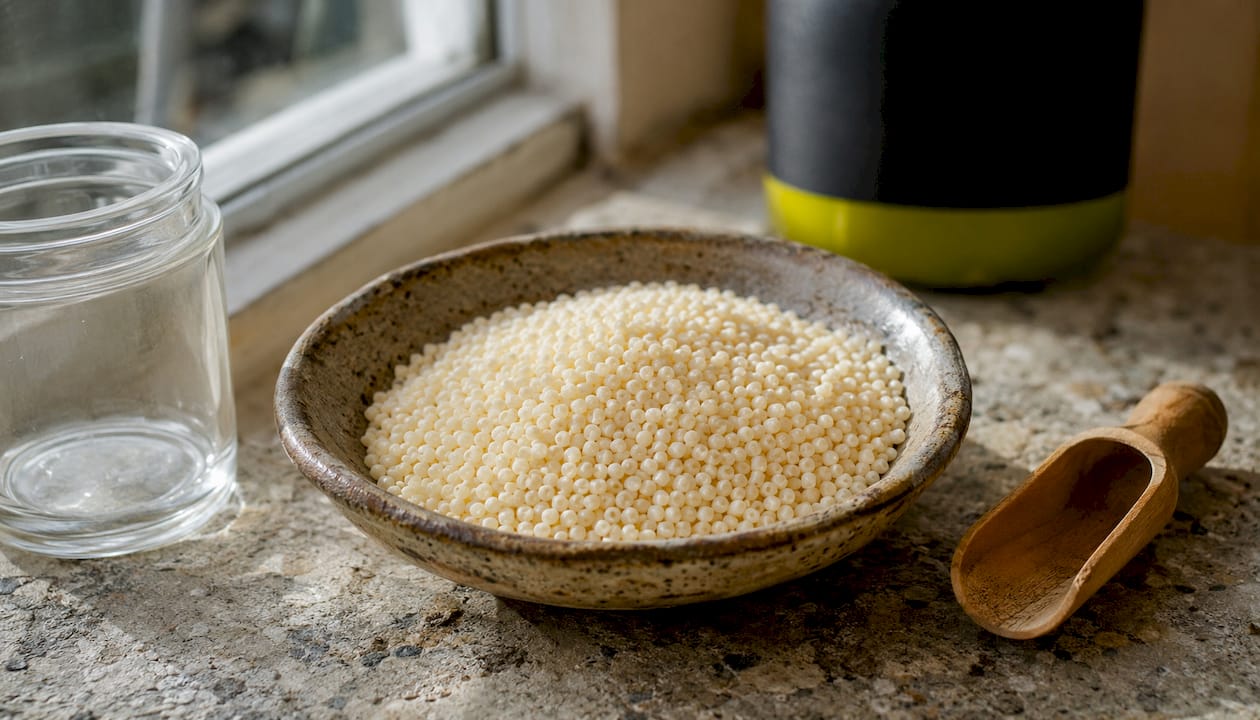
Where confusion creeps in is at the finished-product stage. A manufacturer may add colourants, plasticisers, stabilisers, or other processing aids to PLA before or during production. Those additives are not always migration-tested, and some may introduce substances that the base polymer never would. A PLA cup that contains an untested red pigment, for example, is not the same thing as pure PLA resin, even if the label says “BPA-free biodegradable plastic.”
The practical rule: BPA-free describes the polymer. It does not describe every substance that might migrate from the finished object into your food.
Food-contact rules and what “food-safe” means in the UK
In the UK, food-contact plastics are governed by retained EU Regulation No. 10/2011 on plastic materials and articles intended to contact food, which sets out migration limits and the testing methods manufacturers must use to demonstrate compliance. The Food Standards Agency (FSA) is the primary UK authority overseeing food-contact material safety. In the United States, the FDA has separately cleared PLA for specified food-contact uses under defined conditions, excluding sensitive applications such as infant formula and human milk storage.
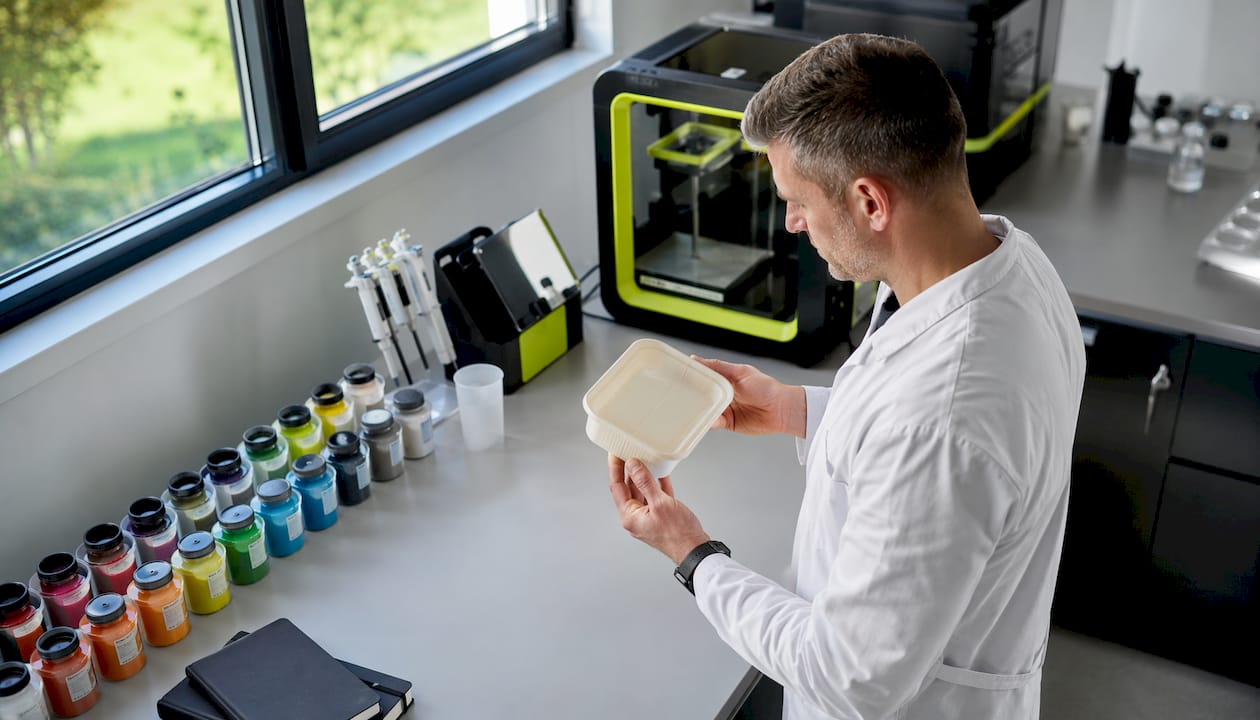
What migration testing actually shows is whether substances transfer from the plastic into food (or a food simulant) at levels below the legal limits. A certificate referencing EU No. 10/2011 tells you the finished product was tested under defined conditions. It does not tell you the product is safe under every possible use condition, particularly at temperatures or with food types not covered by the test.
| Document to request | What it confirms | What it does not confirm |
|---|---|---|
| Migration test report (EU No. 10/2011) | Specific migrants below legal limits under test conditions | Safety at temperatures or food types outside the test |
| Overall migration certificate | Total transfer of substances within legal threshold | Identity of individual migrants |
| Material Safety Data Sheet (MSDS) | Composition and handling hazards of the material | That additives are individually migration-tested |
| Ingredient list for filament/resin | Substances present in the formulation | That each ingredient is food-contact approved |
| FDA notification reference | US regulatory clearance for specified uses | UK/EU compliance or suitability for excluded uses |
When buying PLA products for food contact, ask for all five. A one-line “food-safe” claim on a product page is not a substitute for documented test results.
Why a finished PLA item might still be unsafe for food
The base resin being BPA-free is the starting point, not the finish line. Several real-world factors can make a finished PLA article unsuitable for food contact.
Additives and colourants
Most pigments and fillers used in PLA products are not individually migration-tested. A food-safe resin combined with an untested colourant does not produce a food-safe product. Insist on ingredient-level documentation, particularly for coloured items.
Contamination during 3D printing
Standard brass nozzles used in desktop 3D printers can contain lead, which transfers into printed parts during the melting process. Stainless steel nozzles significantly reduce that risk. Non-food-safe adhesives, bed coatings, and residues from previous filaments can also contaminate a print.
Physical hygiene limits from layer lines
Microscopic crevices between print layers trap bacteria and resist cleaning. Even a chemically safe PLA print can become a hygiene hazard after a single use with wet or fatty food. This is not a problem unique to PLA; it applies to any FDM-printed item regardless of material.
Heat deformation
PLA’s glass transition temperature sits at around 60°C, which means a dishwasher cycle, a microwave, or even hot soup will deform it. Deformation creates new surface irregularities that worsen the bacterial-trapping problem and can accelerate migration.
Common risk scenarios to avoid:
- 3D-printed cups or bowls used repeatedly with hot drinks
- Coloured PLA lids or utensils with no migration certificate
- PLA containers washed in a dishwasher and reused for food
Pro Tip: For any 3D-printed item intended for food contact, use a dedicated stainless-steel nozzle and a single-colour filament with a published migration report. Never assume a printed item is dishwasher-safe, regardless of the base material.
Practical guidance: where PLA is safe to use and what to avoid
PLA works well in a defined set of food-contact situations. Outside those situations, the risks outweigh the benefits of choosing a biodegradable material.
Where PLA is appropriate
Cold, dry, or single-use applications are the safest territory. Rigid PLA packaging for non-fatty, cold foods is widely used commercially, and manufacturer-tested PLA cling films and resealable bags for ambient or refrigerated storage are a reasonable choice when the product carries documented testing. Thezerostore’s compostable cling wrap and resealable food storage bags are examples of consumer products in this category made from bio-polymers including PLA and PBAT.
Where to be cautious or avoid PLA entirely
Hot food and drink are the clearest no. Acidic foods (citrus, vinegar-based dressings) and fatty foods accelerate migration from plastics generally, so untested PLA items should not be used for prolonged contact with these. Dishwasher use is out for most PLA items. Infant feeding equipment, including bottles and weaning accessories, should be specifically certified for that use; the FDA’s clearance for PLA explicitly excludes infant formula and human milk applications.
Prolonged contact with wet food in an untested, coloured, or 3D-printed PLA item carries the most risk. Short, cold, dry contact with a manufacturer-tested product carries the least.
How to confirm a PLA product is food-safe
Whether you are buying a finished product or printing your own, the verification process follows the same logic: document the full production chain, not just the base material.
For purchased PLA products
- Look for an explicit reference to EU Regulation No. 10/2011 or retained UK food-contact guidance on the product page or packaging.
- Request the full migration test report, including the food simulant used, the test temperature, and the duration. A certificate number alone is insufficient.
- Ask for the MSDS and the full ingredient list for the resin or film, including any colourants or processing aids.
- Check whether the manufacturer’s testing covers the specific food types and temperatures you intend to use. A test conducted at 4°C for 10 days does not certify the product for hot food.
- For sensitive uses (infant items, prolonged contact), look for additional specific certifications beyond the standard migration test.
For DIY 3D-printed items
- Source a filament that carries its own migration test report and states compliance with EU No. 10/2011 or an equivalent standard. Some filament suppliers now test each ingredient individually and publish the documentation.
- Use a dedicated stainless-steel nozzle and hotend reserved exclusively for food-contact prints. Never reuse a nozzle that has processed non-food-safe filaments.
- Post-process the printed item: sanding and sealing layer lines with a food-safe coating reduces bacterial trapping, though it does not eliminate it entirely.
- Avoid hot, acidic, or fatty foods even with these precautions. The physical structure of FDM prints makes them unsuitable for repeated wet-food contact regardless of the filament’s chemistry.
- Do not put printed items in the dishwasher. Hand-wash only, and inspect regularly for surface degradation.
PLA, biodegradability, and microplastics
PLA’s environmental credentials are genuine but conditional. The material is industrially compostable, meaning it breaks down in certified composting facilities that maintain high temperatures and specific humidity levels. Home composting is a different matter: PLA degrades far more slowly in a typical garden compost bin and may not break down meaningfully within a normal composting cycle.
The microplastics question is more complicated than most marketing copy suggests. Laboratory research has demonstrated physiological and reproductive stress in marine organisms exposed to PLA microplastics, which means biodegradability does not eliminate the environmental risk if PLA fragments before it reaches a composting facility. PLA that ends up in landfill or the ocean does not biodegrade on any useful timescale.
Compostability labels such as EN 13432 (the European standard) or AS 4736 (the Australian equivalent) confirm that a product will biodegrade under industrial composting conditions within a defined period. They do not guarantee home compostability or safe breakdown in any other environment. When you see these marks, the correct disposal route is a food-waste or industrial composting bin, not general recycling or landfill.
The honest summary: PLA is a better-than-conventional-plastic choice for the environment when it is disposed of correctly. That “when” does a lot of work.
Which lab tests actually prove a PLA item is safe?
Not all test documentation is equally useful. Here is what each type of evidence actually demonstrates.
| Test type | What it shows | Key limitation |
|---|---|---|
| Overall migration test | Total mass of substances transferred to food simulant | Does not identify which substances migrated |
| Specific migration test | Whether a named substance (e.g. lactide) exceeds its specific migration limit | Only covers the substances tested; others may not be assessed |
| Extractables and leachables study | Identifies and quantifies all extractable substances under defined conditions | More thorough but less commonly provided for consumer goods |
| Ingredient-level migration testing | Each additive and colourant tested individually for migration | Highest assurance; rare outside specialist suppliers |
| Compostability certificate (EN 13432) | Confirms biodegradation under industrial composting conditions | Says nothing about food-contact safety |
Migration tests are conducted using food simulants (water, acetic acid, ethanol, or vegetable oil) at set temperatures and durations. A test run at 4°C for 10 days is relevant to cold storage; it tells you nothing about what happens at 70°C or with a fatty food. The safety assessment literature confirms that PLA’s primary migrants are lactic acid and lactide, both of which convert to lactic acid, a substance already found in food. That is reassuring for the base polymer. It is not reassuring for an untested additive package.
Pro Tip: Always request the full test report, not just a certificate. The report should state the simulant, temperature, duration, and the specific substances assessed. If a supplier cannot provide this, treat the product as unverified for food contact.
Key takeaways
PLA is inherently free of BPA, but food safety depends on the full production chain: the resin, every additive, and the manufacturing process must all be verified through documented migration testing.
| Point | Details |
|---|---|
| PLA contains no BPA | Pure PLA is a lactic acid polymer; bisphenol A is not part of its chemistry. |
| Additives change the picture | Colourants and processing aids are rarely migration-tested; always request ingredient-level documentation. |
| Heat is a hard limit | PLA softens at around 60°C, making dishwashers and hot food unsuitable for most PLA items. |
| Demand the full test report | A certificate number is not enough; ask for simulant, temperature, duration, and substances assessed. |
| Thezerostore’s approach | Thezerostore’s compostable cling wrap and resealable bags are made from bio-polymers including PLA and PBAT, with product specifications and certifications listed on their product pages. |
Why the “BPA-free” label is only half the story
The conversation around PLA and food safety tends to collapse into a single question: does it contain BPA? That is the wrong frame, and it leads people to make poorly informed choices.
BPA became the villain of the plastics story for good reason. It is an endocrine disruptor with a well-documented mechanism of harm, and its presence in polycarbonate bottles and epoxy can linings was a genuine public health concern. But the lesson from that episode was not simply “avoid BPA.” It was that the safety of a food-contact material depends on its entire chemical profile, its physical behaviour under use conditions, and the integrity of its production chain.
PLA passes the BPA test easily, because BPA was never part of it. What it cannot automatically pass is a broader food-safety assessment, because that requires knowing what else is in the formulation, how it was processed, and whether the finished item can actually be kept clean. A 3D-printed PLA cup with an untested pigment and a brass-nozzle contamination history is not a safe food-contact item, even though it is technically BPA-free and biodegradable.
The brands worth trusting in this space are the ones that publish their migration reports, name their testing standards, and are specific about what their products are and are not suitable for. Vague “eco-friendly” or “non-toxic” claims without documentation are a red flag, not a reassurance. Thezerostore’s approach of listing certifications and product specifications on individual product pages reflects the kind of transparency that actually means something. That is the standard worth holding every PLA product to.
Ready-made PLA alternatives with documented credentials
If the verification checklist above feels like a lot of work for a roll of cling film, that is a fair reaction. The practical shortcut is to buy from manufacturers who have already done the testing and publish the results.
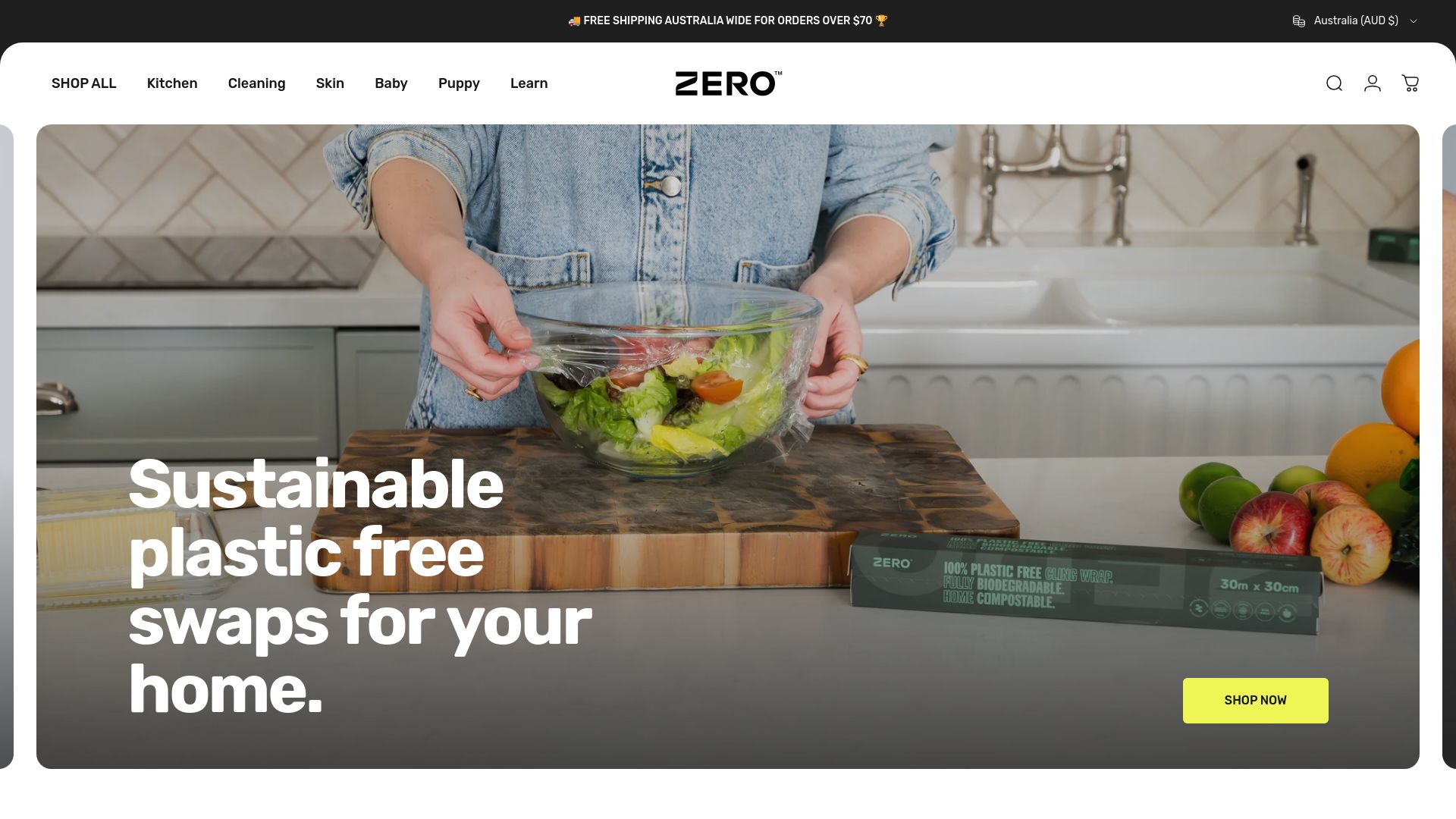
Thezerostore’s plastic-free cling wrap and resealable food storage bags are made from bio-polymers including PLA and PBAT, marketed as compostable and free from harmful chemicals and microplastics. Product pages include specifications and certification details, so you can check the documentation before you buy rather than chasing a supplier for paperwork after the fact. For households wanting to move away from conventional cling film without spending an afternoon reading migration test methodology, that transparency is the point. Visit Thezerostore’s product pages to review the certifications and find the option that fits your household’s food storage needs.
Useful sources and further reading
The following sources are worth consulting directly if you want to verify the claims in this article or read the original regulatory and scientific material.
- Food Standards Agency (FSA): The UK authority on food-contact material safety. The FSA publishes guidance on materials and articles in contact with food, including retained EU regulations. food.gov.uk
- EU Regulation No. 10/2011: The retained regulation governing plastic materials intended for food contact in the UK. Sets out the positive list of authorised substances and migration limits.
- Safety assessment of polylactide (PLA) for use as a food-contact polymer: The foundational peer-reviewed safety assessment concluding that PLA is generally recognised as safe for food-contact uses, with lactic acid and lactide as the primary potential migrants. Available via PubMed and ScienceDirect.
- FDA notification: Polylactide food contact substance: The US regulatory filing outlining permitted uses and exclusions for PLA in food-contact applications. Available from the FDA.
- PLA microplastics and marine organisms: Peer-reviewed research on the ecological effects of PLA microplastics. ScienceDirect.
- PMC review articles on bioplastics and food safety: For broader context on bioplastic migration and environmental behaviour, the PMC database hosts several relevant open-access reviews at pmc.ncbi.nlm.nih.gov.
When in doubt about a specific product, request the migration test report and MSDS directly from the manufacturer. Regulatory guidance evolves; always confirm current requirements with the FSA or a qualified food-safety professional for your specific use case.
This article is general information, not professional legal or food-safety advice. For your specific situation, consult the Food Standards Agency or a qualified food-contact materials specialist.
Share:
What is PLA: a UK shopper's guide to plant-based food storage
Compostable vs biodegradable: what UK shoppers need to know